
Chet's following report explains the Core Story concept perfectly. So with appreciation and compliments to Chet, please read his report. It is very thorough and enlightening.
Here’s how to build
a KILLER presentation
that literally triples sales
(with tons of proof and examples below)
by
Chet Holmes
Imagine I could put you in a giant stadium right now as the presenter, and
the entire audience is completely comprised of your most perfect prospects. Are
you ready right now? Could you walk out on that stage and present to every one
of them and do it perfectly? Now before you say yes, let me make the stakes
higher. Before you walk out there, the audience is told: "You had to come,
but you don't have to stay. If this person (you) fails to keep your interest,
you can simply get up and leave."
Now let me even further complicate the situation by telling you the good
news and the bad news.
The good news: At any given time 3% of your prospects are currently in the
market to buy your product or service and looking right now to get it. Another
6-7% are open to it, but not currently looking. The
other 90% are divided into three nearly equal categories: A) Not
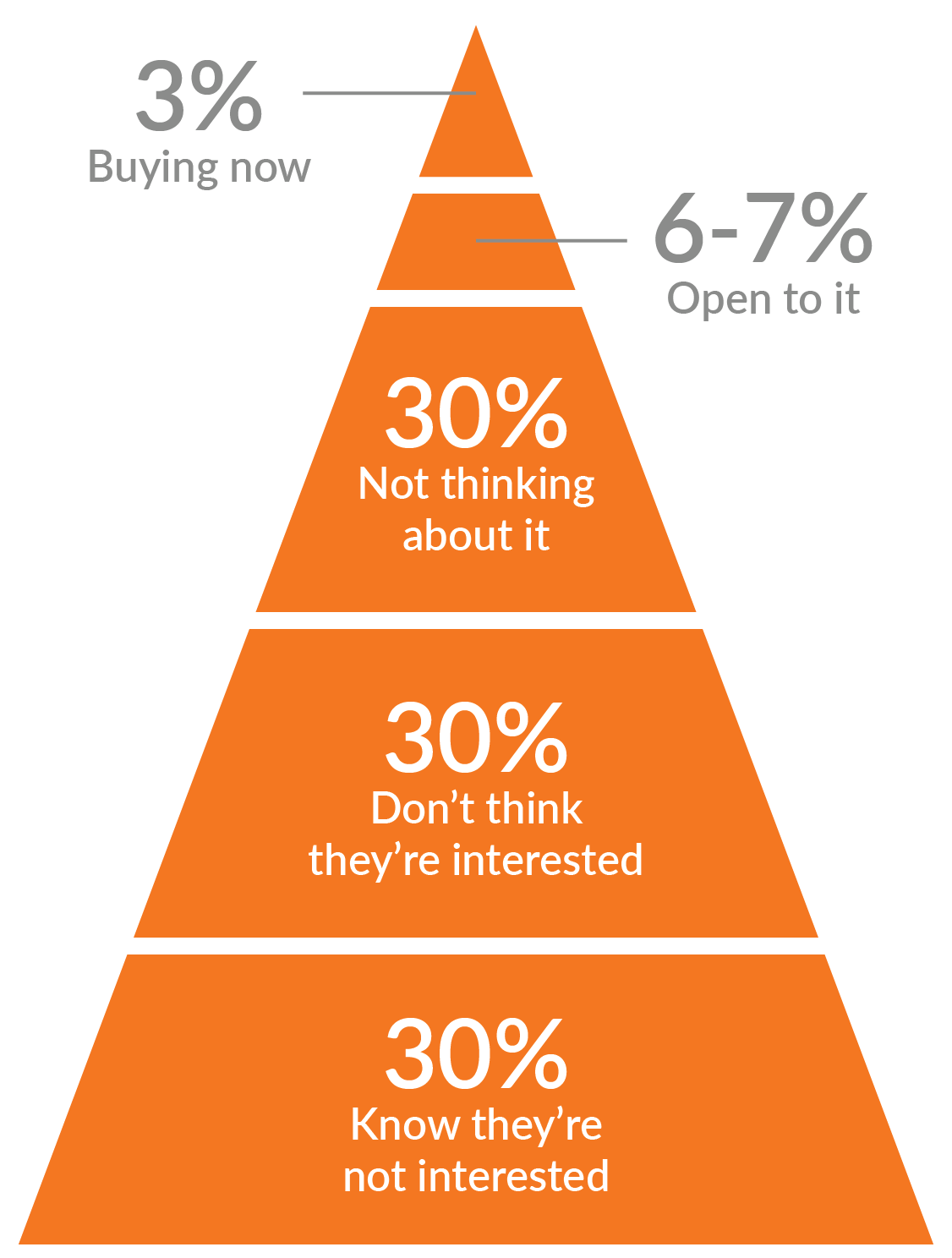
really thinking about it right now. B) Think they're not interested (but might
be, if you did a good job at presenting to them.) C) They KNOW they're not
interested.
So let's say you sell brooms. And let's say it's a fantastic broom. But
remember 90% of the audience isn't in the market for your broom at this time.
At least they think they're not interested. That means if you walk out there
and start right off saying how great your brooms are, 90% of your audience is
going to get up and leave.
So you need to open your stadium pitch (as I call it), with what I call
"wows." This means that all great presentations start off with
information that makes your prospects say: "wow, I didn't know that."
The focus must be on THEM and things of interest to THEM, not you. So rule number
one of a great presentation is that it must be focused on the prospect and not
on you (at least not initially.)
I've built presentations that increase closing ratios from one out of ten to
eight out of ten. I've even built presentations that dramatically increase your
ability to get in front of prospects in the first place. How? Let's bring that
stadium pitch down to its most practical application; Offer prospects something
of value outside your product or service. Something important
to THEM.
Let me give you a case in point. I have a client who sells employee benefits
and insurance to companies. His sales team was used to calling up a client and
saying: "We want to come and talk to you about your health care
benefits."
Since 97% of prospects THINK they are happy with their current broker,
that's a really hard call to make. However, when they created a presentation
that pointed out: "The Five Dangers Facing All Employers and How Knowing
What Those DANGERS Are Can Dramatically Reduce Costs and Increase
Profits," it made not just the sale go better, but also getting the
appointment go much better.
Meaning that information that is of value to THEM, like "Five Dangers
Facing You in Your Business," creates what I call a "superior access
vehicle." More..
Another client of mine sells telephone systems. Prior to the learning curve
in this article, they'd call prospects and ask the prospect: "We want to
come and talk to you about getting a new telephone system." Needless to
say, the appointment setting process was slow going. However, when they built
THE ULTIMATE PRESENTATION, one that offered (something like): "How You're
Wasting Money In Five Major Areas of Your Voice and Data Spending," --
Suddenly, they went from getting three appointments per week (with four
salespeople trying all day) to getting 30 appointments per week. This effort has
already tripled their pipeline in a single year.
So rule number one, again, for building a killer presentation is to have
information that is OF VALUE to your prospects even if they have never heard
about your products or services. Information that is above and beyond the
product or service you are offering will be considered extremely valuable to
them.
I had another client that was trying to sell law books to lawyers. Over the
years, they had been reduced to talking to just the librarians in these law
firms. And since the lawyers are the ones using the law books, their ability to
get new products into the market became severely hamstrung.
We helped them build a presentation that laid out:
"The Five Most Dangerous Trends Facing All Major Law Firms Today,"
which resulted in meetings with entire committees of lawyers. The data was
excellent, legitimate and packed with bad news. Oh, did I mention the part
about bad news?
A great presentation is loaded with bad news to your prospects. Why? Because bad news motivates. We'd get in front of a group of
lawyers and show them that lawyers keep growing, but the annual billings are
flat (less money per lawyer); that their firms would be sued (something like
44% of large law firms will be sued by unhappy or dissatisfied clients); that
the case law from which they must find their information is out of control now,
with more than THREE MILLION cases to chose from when trying to find a single
precedent. This presentation was packed with bad news. Much of this news had
nothing to do with law books. It doesn't matter. Bad news motivates, even if it’s
unrelated.
Your prospect, when viewing a great deal of bad news, will suddenly feel the
need to take some action. Any action they take will make them feel better. In
the case of the law book company, every lawyer in the room wanted more
information or wanted to purchase the law books outright, after they saw the
presentation.
That said, the more the data in the presentation sets up a need for your
product or service, the higher your closing ratio. So in the case of the law
firm, the massive case law to be studied created a need for law books that
already studied that for you. Plus, we tied the litigation against lawyers
directly to the massive case law, so those two pieces of seemingly unrelated
data, pieced together with other data made the bad news more excruciating. Or
should I say "motivating." This sales tool was fantastic.
So rule number two to building a killer presentation is that the data should
"set up a buying criteria" in which your product or service becomes
the most logical choice. When my telephone client laid out all the ways most
companies were wasting money on their voice and data spending, it made the
prospects open their arms and invite my client to look at how they might help
them. So it often turned out a new system was almost always the solution to
reducing cost. And that's true, by the way. Many companies are paying
maintenance costs on an old system when the payments on a new system would be
less and do more.
What's your client's current buying criteria? Is it
price? Easy to overcome with the right presentation.
Is it that they want to buy only from the biggest provider? Easy
to overcome with the right presentation. Is it that they don't think
they even need what it is that you sell? Easy to overcome
with the right presentation. Data can motivate your prospects in all and
any of the situations mentioned.
I have a client that is a distributor in a market where they once had only
four main competitors. In the past several years, many other types of companies
have added my client's type of product as an add-on. Since it's not their main
product, these hundreds of new competitors can sell it even cheaper than my client
can. Result? My client was in big trouble and fading fast.
Presentation to the rescue.
We used data, compelling and riveting data to show that these competitors
didn't know anything about this particular industry and as a result, in the
long run, poor choices in purchasing were going to cost their penny wise and
pound foolish buyers a LOT more money later. The presentation set up a buying criteria where price became secondary to
expertise. Will that work with you? I do not know. But I DO know this. There's
no situation where one of these presentations, properly prepared, can't help
overcome any challenge you may be facing.
Declining market? Price is the main motivator? Inability
to get appointments? Inability to get to see the
higher decisions makers? All of these challenges can be met with a
fantastic presentation.
The Core Story.
I call this "Your Core Story," or your stadium pitch, and it serves
another extremely valuable purpose. I had one client who used to take four
months to train a new person on all the subtleties of why a prospect should buy
their product. The Core Story used data as the motivator and suddenly, this
core story could train an outsider how to REALLY sell this product and in a
single pass through the information.
So a great core story makes for a fantastic new-hire training tool.
How to build a core story.
If you want to be the ultimate player in your market, you have to take the
time to carefully craft one of these, using data as a powerful access vehicle
as well as an urgent motivator for your otherwise slow moving clients to make
faster and more urgent decisions. Before you read the steps, and become
discouraged, let me tell you that there is a group that simply does this for
you.
They will interview you and a few other appropriate people in your company
to kick off the process of preparing a KILLER presentation; filled with
poignant and significant research about your market; research that your client
will find fascinating; research that is compelling enough to get you more meetings;
and critical, research that is highly motivating to get your client to want to
buy faster-and research that, hopefully, in some way, "sets up a buying
criteria" where YOU are the MOST logical choice. YOU are the ONLY one
these prospects want to buy from.
They will come back with not just the research, not just the facts, but
visually arresting graphics. Yes, a KILLER presentation has graphics on every
panel. Vivid visuals, photos that triple the impact of your words, graphs that
visually illustrate your points, pie charts that point out their problems, and
dollar signs in all the right places to show them how you help them save, earn
or increase some area of their world.
85% of the information in the brain is taken in through the eyes. Studies
show that visuals nearly triple the communication experience. So don't even
think about presenting anything to anyone, if you're not going to use visual
aids.
This group will give you an awesome stadium pitch, fully illustrated with
your logo on every panel. If you want to know how you might use one of these
and you're not sure, it's certainly free to talk to this group.
They're called Empire Research Group and they are little known outside the
circle of my clients, as most companies are not wise enough to utilize data
this effectively. This is to your benefit. You can reach Empire Research Group
here: Empire
Research Group.
Empire's Research and Core Story building services began many years ago when
I was building these core stories for my billion dollar clients. Clients would
pay me $80,000 to build these and I would commission out all the research to an
elite team of top researchers. I would then sit around on the floor (too much
data to put on a desk) with piles of the raw data all around me and begin to
see where I could piece together all these disconnected pieces of raw data to
create the "wows" or find the "bad news" that would
motivate -- at the same time as position my clients. This process alone is
critical and difficult. In one case we were building a presentation for a client
who wanted to target day-spas.
The researchers got me the numbers and I saw that there were 16,000 day spas
in the U.S. But to my utter shock, another piece of disconnected data showed
that there were maybe 200 of them only 15 years ago. Bad news if you're a day
spa. Your market is massively competitive. Two pieces of data over a 15 year period, put together on a single panel to equal bad news!
After I finished building the raw data into the final product, I would then
pass back my finished product to the researchers to show them how I had
utilized their data.
After years and years of doing this, this very bright research team began to
get the hang of this process and they began to go a lot further with the
assignments I gave them. Before I knew it, they were getting these things
pretty far along and that's when I realized that this service could now be
expanded outside of the billion dollar clients I was accustomed to working
with.
So what I once charged $80,000 to produce, you can now get for a mere four
figure investment, affordable by almost any company or sole individual looking
to slaughter the competition.
Now, that said, if you cannot afford a four figure investment to simply have
someone do this for you, here's what you need to do on your own.
Step One: Research your industry over a thirty year period.
That's where you'll find trends that no one else has spotted. How many of everything
was there thirty years ago, twenty years ago, ten
years ago? Even you will get "wows" from looking at stats over time.
For example, with the day spas, I had asked for the failure rate of day spas.
The research revealed that they weren't failing at all. They were growing like
wildfire. So look at data over time. It'll really fascinate you.
Step Two: Look for the bad news. That's what motivates.
Specifically, look for bad news that you might be able to tie to a solution
that involves your product or service. Never lie. Never make up anything. But
in the example above, we were looking for failure rate as a "pain"
point when we found that just wasn't true. But what we did find is that because
these day spas are such a raging success, everyone and their uncle is opening
one and the market is getting massively competitive. Bad
news. And it's the truth.
Step Three: Manipulation of that data is the most difficult
part of it. It is an art form onto itself. Stack the info, cross reference the
info, blend it with other info, etc. When I built these
myself, I would do all the original panels by hand on 3X5 index cards. This way
you can erase info, and keep shifting the order of how you want to present the
info, all in a delicate balance of insight that eventually leads to that
prospect wanting YOUR product or service over all of your competitors.
Step four: Really important. Do NOT pitch your product
until the very end. You want the material in the front and 3/4 through to all be a "set up." Then somewhere toward the end, you
want a section that says: "What to look for in X type of provider."
At this point you would present all this data about yourself without really
saying it's you. In the telephone company example, they presented: "What
to look for in your telephone system provider" and they had five things
and every one of them set them up to be the most logical provider.
So when they came to the end of the presentation it was hardly necessary to
pitch themselves. They had already laid out, in
logical progression, the best company to work with and the buyer was nodding
all the way. So now you can have a small section at the end that says:
"Would you like to know a little about us?" If you've done a great
job, no one will ever say now. They'll all say yes. And there is where you put
some panels about yourself.
A great title is critical.
Here's a great title for everyone: "The Five Most Dangerous Trends
Facing (your prospect's type of company or issue here) XYZ Type
Companies/consumers." If you got a call that offered to teach you the five
most dangerous trends facing your business, wouldn't you be interested in
hearing a little more? That's pretty irresistible. It still has to be sold
effectively, but here's the critical point: it's easier to
sell! It's easier to persuade someone to see critical info for their survival
than it is to convince them to see you come pitch your product or service.
And here's the best part
This approach genuinely serves them. You will legitimately present them with
excellent compelling data (if you do this process properly as outlined). You
will genuinely find things that they will be grateful to know. "The best
among us is servant to us all." So serve your market by knowing more than
anyone else about what’s going on.
More details:
The second panel is always your "Areas Covered" panel. This is
your pre-sell opportunity. It should make their mouth water with anticipation.
Start with wows after that, perhaps a big overview of their industry and its
growth or decline over the years.
I had a client that sold to car dealers. Take a guess what's happening in
that market? Do you think there are more car dealers or fewer car dealers than
there were say, fifty years ago? Our research revealed that car dealerships
have gone from 47,000 50 years ago down to 21,000 today. That's a massive
decline. But guess what? The dealerships are bigger. Much
bigger. In fact, you have half the dealers selling three times the
amount of cars. But take a guess what the internet has done to price shopping? Devastating. In any event, in that core story, we came out
of the box with this data, right in the first several panels. It totally
captures the attention of your prospect and sets you up as a much more
respected provider.
In summary, your core story can accelerate:
. Training
. Client access
. Decision making process
. Appointment setting
. Closing skills
. Rapport opportunities
. Increased credibility,
And so much more. If you build it, they will buy!
Or, you can certainly have Empire Build it for you. You can reach them again
here: Empire
Research Group.
To your success!
There is a great deal of information on how to utilize a core story in The
Business Growth Masters Series. To learn more about that series, you
can attend a fantastic executive seminar right over the web, but going to: https://www.chetholmes.com/entwebinar.htm
Chet Holmes is President and CEO of Chet Holmes International, a marketing, mgmt and sales firm that specializes in helping
companies develop strategic identities and then building all the details
necessary to support a preeminent position in their market. Chet has had more
than 60 Fortune 500 clients and has 60 training products selling in 23
countries.
Copyright 2003-2009. Reprint with permission only.